Client
Tripcart
Impact area
SaaS for tour operators
Work
Facebook and Instagram advertising
Goal
Product signups and paid purchases
Project overview
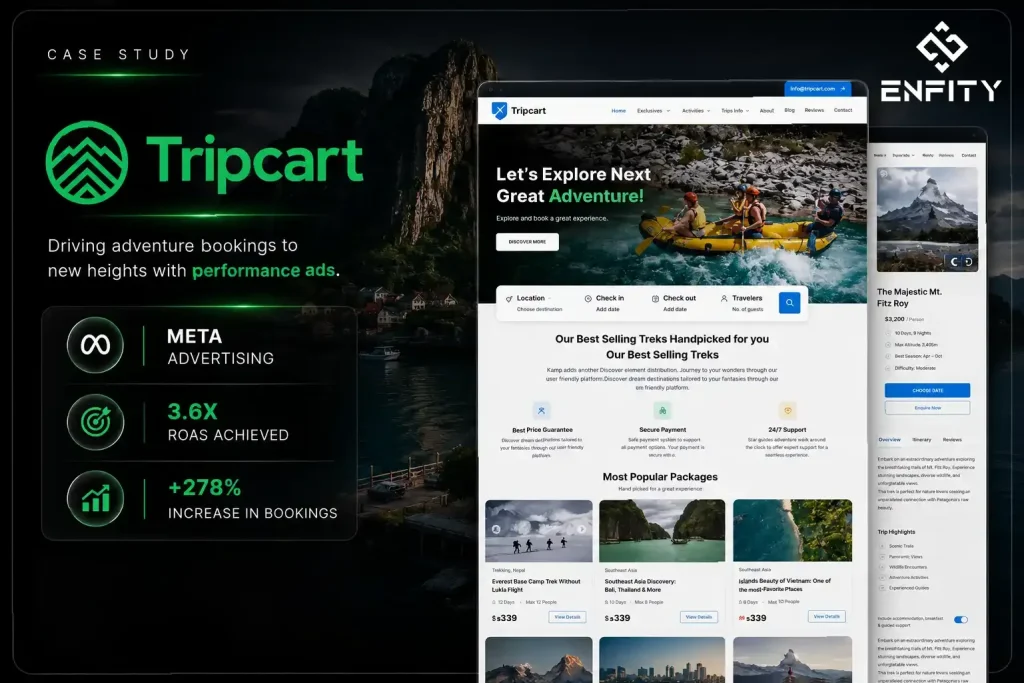
Tripcart is an all-in-one SaaS platform for tour operators and travel agencies. Like Shopify, but built for travel, it lets a company launch a travel website, add tours, take payments through local gateways and manage bookings, reviews and customer messages.
As a new product entering a global market, Tripcart had no advertising history to learn from. It needed to know where it would sell and what a customer would cost.
Our key objective was to drive product signups and paid subscription activations, treating the first campaigns as market validation as much as acquisition.
The results
3–5% signup-to-paid rate
Regional cost-per-signup benchmarks
5 messaging angles tested
Remarketing audiences built
The testing phase gave Tripcart clear answers. It now knows which countries bring the most signups, which bring the lowest cost per acquisition and which markets do not work at the current price.
Purchases were not the first goal, but signups began converting to paid on their own: 3–5% of all signups bought the product. That gave Tripcart a working view of free-trial-to-paid conversion, customer acquisition cost and lifetime value for planning the next phase.
- Viable countries identified for go-to-market
- Cost per signup and per purchase defined by region
- Messaging insights fed back into onboarding
- Remarketing pools built: email list, site visitors, video viewers, product-view events and lookalike audiences
Before: No advertising data, no known cost per signup or purchase and no idea which of many possible countries would convert.
After: Data-backed markets, cost benchmarks by region, a proven set of messages and warm audiences ready for lower-cost retargeting and scaling.
The execution
The challenge
Tripcart had never advertised before. There was no data on cost per signup or purchase and no conversion benchmarks for any region.
Its market is tour operators worldwide, so the right countries had to be found by testing many of them, not by guessing. We set the campaigns up as market validation and acquisition at the same time.
The solution
We focused on fast global testing, audience segmentation and message validation, in three phases.
Phase 1: Multi-country testing
We launched Meta campaigns across a mix of emerging and mature markets. The rollout showed which audience segments had the strongest intent, which markets converted at the best cost and where the messaging needed localizing.
Phase 2: Creative and messaging experiments
We tested five messaging angles, each aimed at a different motivation, and produced short videos, vertical reels, static graphics and carousel ads for every angle:
- Speed and ease of setup
- Higher profit retention
- Local trust and payment security
- Selling multiple product types online
- Lower cost than traditional solutions
Phase 3: Landing pages and pixel setup
For accurate attribution, we installed the Meta pixel with conversion events, set Signup as the primary conversion and Purchase as the secondary one, and matched each campaign to A/B tested landing pages.